Radioplayer is a radio technology platform, owned by UK radio broadcasters and operated under licence in some other countries. It operates an internet radio web tuner, a set of mobile phone apps, an in-car adaptor, and a growing range of integrations with other connected devices and platforms. Radioplayer is operated by UK Radioplayer Ltd which is a not-for-profit organisation owned by UK radio broadcasters. Initial shareholders were the BBC, Global Radio, GMG Radio, Absolute Radio and RadioCentre. After consolidation in the radio market, current shareholders are the BBC, Global Radio, Bauer Media Group and RadioCentre. == History == Launched in the UK on 31 March 2011, Radioplayer set out to offer a simple and accessible way to listen to radio via the internet. It contained 157 stations at launch. Initially working internally at the BBC for Tim Davie, then Director of BBC Audio & Music, Michael Hill led the project since March 2009; he was made Managing Director of UK Radioplayer Ltd on 28 July 2010. At launch, Radioplayer was a simple and straightforward Flash-based radio player, linked-to by radio stations on their own website. The player included searching and bookmarking across all of UK radio station content. On 5 October 2012, Radioplayer launched a mobile app on iOS phones with an Android version following shortly afterwards. The apps are unavailable for download outside the United Kingdom. This was followed by a tablet app on 25 September 2013. The apps also support Android Wear, Android Auto, Smart Device Link, Apple Watch and Apple CarPlay. They are also compatible with Chromecast and Airplay. In September 2016, Radioplayer announced it had been chosen by Amazon to integrate with their new voice-controlled 'Echo' device, ahead of its UK launch. In July 2017, Radioplayer integrated with the Sonos and Bose multi-room speaker platforms. UK Radioplayer currently contains around 500 UK stations, from Ofcom-licensed broadcasters. Online-only 'sister-stations' can also be added, but only by broadcasters with Ofcom licences which have been on the platform for over a year. == Radioplayer Car == Radioplayer Car was announced in September 2014 as a hybrid radio receiver that switches between FM, DAB and streaming to find the strongest signal. Speaking in Oslo in June 2015, Michael Hill said that he hoped to launch the product in the UK and Norway during the summer of 2015. In February 2017, Radioplayer Car was launched. It was marketed as the world’s first voice-controlled hybrid radio adaptor for car stereos. A small box, fitted behind the dashboard, links to the auxiliary input on an existing car radio. It connects wirelessly via Bluetooth to the driver’s smartphone by an app. The adaptor enabled drivers to listen to their own smartphone music collections using Bluetooth, take hands-free calls, listen to inbound text messages and receive instant audio travel news, customised by GPS to their location and direction of travel. The hardware was manufactured under licence by car audio interfaces supplier Connects2, and Hyde Park Corner was promoted as the preferred installer of the audio equipment. There were several spin-off benefits of the Radioplayer Car project, including the creation of the hybrid radio metadata API for cars, known as the 'WRAPI' (Worldwide Radioplayer API). == International == Through a separate company called Radioplayer Worldwide, Radioplayer technology is licensed to a number of different territories.
Outline of robotics
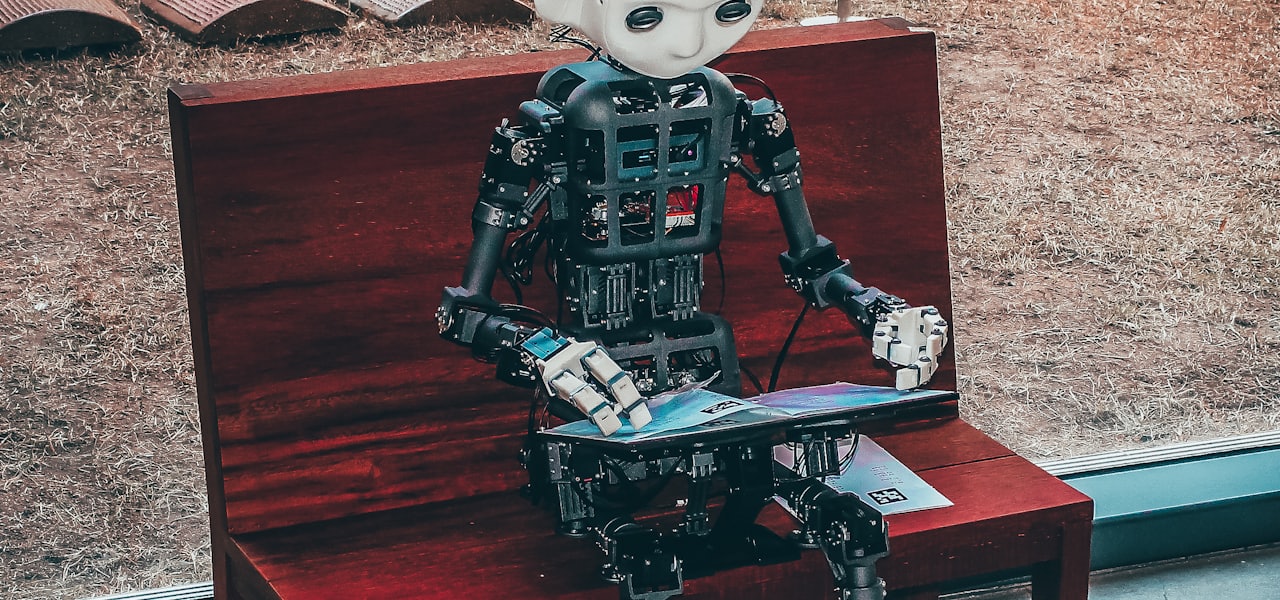
The following outline is provided as an overview of and topical guide to robotics: Robotics is a branch of mechanical engineering, electrical engineering and computer science that deals with the design, construction, operation, and application of robots, as well as computer systems for their control, sensory feedback, and information processing. These technologies deal with automated machines that can take the place of humans in dangerous environments or manufacturing processes, or resemble humans in appearance, behaviour, and or cognition. Many of today's robots are inspired by nature contributing to the field of bio-inspired robotics. The word "robot" was introduced to the public by Czech writer Karel Čapek in his play R.U.R. (Rossum's Universal Robots), published in 1920. The term "robotics" was coined by Isaac Asimov in his 1941 science fiction short-story "Liar!" == Nature of robotics == Robotics can be described as: An applied science – scientific knowledge transferred into a physical environment. A branch of computer science – A branch of electrical engineering – A branch of mechanical engineering – Research and development – A branch of technology – == Branches of robotics == Adaptive control – control method used by a controller which must adapt to a controlled system with parameters which vary, or are initially uncertain. For example, as an aircraft flies, its mass will slowly decrease as a result of fuel consumption; a control law is needed that adapts itself to such changing conditions. Aerial robotics – development of unmanned aerial vehicles (UAVs), commonly known as drones, aircraft without a human pilot aboard. Their flight is controlled either autonomously by onboard computers or by the remote control of a pilot on the ground or in another vehicle. Android science – interdisciplinary framework for studying human interaction and cognition based on the premise that a very humanlike robot (that is, an android) can elicit human-directed social responses in human beings. Anthrobotics – science of developing and studying robots that are either entirely or in some way human-like. Artificial intelligence – the intelligence of machines and the branch of computer science that aims to create it. Artificial neural networks – a mathematical model inspired by biological neural networks. Autonomous car – an autonomous vehicle capable of fulfilling the human transportation capabilities of a traditional car Autonomous research robotics – Bayesian network – BEAM robotics – a style of robotics that primarily uses simple analogue circuits instead of a microprocessor in order to produce an unusually simple design (in comparison to traditional mobile robots) that trades flexibility for robustness and efficiency in performing the task for which it was designed. Behavior-based robotics – the branch of robotics that incorporates modular or behavior based AI (BBAI). Bio-inspired robotics – making robots that are inspired by biological systems. Biomimicry and bio-inspired design are sometimes confused. Biomimicry is copying the nature while bio-inspired design is learning from nature and making a mechanism that is simpler and more effective than the system observed in nature. Biomimetic – see Bionics. Biomorphic robotics – a sub-discipline of robotics focused upon emulating the mechanics, sensor systems, computing structures and methodologies used by animals. Bionics – also known as biomimetics, biognosis, biomimicry, or bionical creativity engineering is the application of biological methods and systems found in nature to the study and design of engineering systems and modern technology. Biorobotics – a study of how to make robots that emulate or simulate living biological organisms mechanically or even chemically. Cloud robotics – is a field of robotics that attempts to invoke cloud technologies such as cloud computing, cloud storage, and other Internet technologies centered around the benefits of converged infrastructure and shared services for robotics. Cognitive robotics – views animal cognition as a starting point for the development of robotic information processing, as opposed to more traditional Artificial Intelligence techniques. Clustering – Computational neuroscience – study of brain function in terms of the information processing properties of the structures that make up the nervous system. Robot control – a study of controlling robots Robotics conventions – Data mining Techniques – Degrees of freedom – in mechanics, the degree of freedom (DOF) of a mechanical system is the number of independent parameters that define its configuration. It is the number of parameters that determine the state of a physical system and is important to the analysis of systems of bodies in mechanical engineering, aeronautical engineering, robotics, and structural engineering. Developmental robotics – a methodology that uses metaphors from neural development and developmental psychology to develop the mind for autonomous robots Digital control – a branch of control theory that uses digital computers to act as system controllers. Digital image processing – the use of computer algorithms to perform image processing on digital images. Dimensionality reduction – the process of reducing the number of random variables under consideration, and can be divided into feature selection and feature extraction. Distributed robotics – Electronic stability control – is a computerized technology that improves the safety of a vehicle's stability by detecting and reducing loss of traction (skidding). Evolutionary computation – Evolutionary robotics – a methodology that uses evolutionary computation to develop controllers for autonomous robots Extended Kalman filter – Flexible Distribution functions – Feedback control and regulation – Human–computer interaction – a study, planning and design of the interaction between people (users) and computers Human robot interaction – a study of interactions between humans and robots Intelligent vehicle technologies – comprise electronic, electromechanical, and electromagnetic devices - usually silicon micromachined components operating in conjunction with computer controlled devices and radio transceivers to provide precision repeatability functions (such as in robotics artificial intelligence systems) emergency warning validation performance reconstruction. Computer vision – Machine vision – Kinematics – study of motion, as applied to robots. This includes both the design of linkages to perform motion, their power, control and stability; also their planning, such as choosing a sequence of movements to achieve a broader task. Laboratory robotics – the act of using robots in biology or chemistry labs Robot learning – learning to perform tasks such as obstacle avoidance, control and various other motion-related tasks Direct manipulation interface – In computer science, direct manipulation is a human–computer interaction style which involves continuous representation of objects of interest and rapid, reversible, and incremental actions and feedback. The intention is to allow a user to directly manipulate objects presented to them, using actions that correspond at least loosely to the physical world. Manifold learning – Microrobotics – a field of miniature robotics, in particular mobile robots with characteristic dimensions less than 1 mm Motion planning – (a.k.a., the "navigation problem", the "piano mover's problem") is a term used in robotics for the process of detailing a task into discrete motions. Motor control – information processing related activities carried out by the central nervous system that organize the musculoskeletal system to create coordinated movements and skilled actions. Nanorobotics – the emerging technology field creating machines or robots whose components are at or close to the scale of a nanometer (10−9 meters). Passive dynamics – refers to the dynamical behavior of actuators, robots, or organisms when not drawing energy from a supply (e.g., batteries, fuel, ATP). Programming by Demonstration – an End-user development technique for teaching a computer or a robot new behaviors by demonstrating the task to transfer directly instead of programming it through machine commands. Quantum robotics – a subfield of robotics that deals with using quantum computers to run robotics algorithms more quickly than digital computers can. Rapid prototyping – automatic construction of physical objects via additive manufacturing from virtual models in computer aided design (CAD) software, transforming them into thin, virtual, horizontal cross-sections and then producing successive layers until the items are complete. As of June 2011, used for making models, prototype parts, and production-quality parts in relatively small numbers. Reinforcement learning – an area of machine learning in computer science, concerned with how an agent ought to take actions in an environment so as to maximize some notion of cumulative reward. Robot
Five safes
The Five Safes is a framework for helping make decisions about making effective use of data which is confidential or sensitive. It is mainly used to describe or design research access to statistical data held by government and health agencies, and by data archives such as the UK Data Service. It is not an internationally accepted standard. Two of the Five Safes refer to statistical disclosure control, and so the Five Safes is usually used to contrast statistical and non-statistical controls when comparing data management options. == Concept == The Five Safes proposes that data management decisions be considered as solving problems in five 'dimensions': projects, people, settings, data and outputs. The combination of the controls leads to 'safe use'. These are most commonly expressed as questions, for example: These dimensions are scales, not limits. That is, solutions can have a mix of more or fewer controls in each dimension, but the overall aim of 'safe use' independent of the particular mix. For example, a public use file available for open download cannot control who uses it, where or for what purpose, and so all the control (protection) must be in the data itself. In contrast, a file which is only accessed through a secure environment with certified users can contain very sensitive information: the non-statistical controls allow the data to be 'unsafe'. One academic likened the process to a graphic equalizer, where bass and treble can be combined independently to produce a sound the listener likes, which has proven to be a very useful metaphor. This 2023 Data Foundation webinar is an expert discussion of how the elements interact, including an excellent introductory representation. There is no 'order' to the Five Safes, in that one is necessarily more important than the others. However, Ritchie argued that the 'managerial' controls (projects, people, setting) should be addressed before the 'statistical' controls (data, output). The Five Safes concept is associated with other topics which developed from the same programme at ONS, although these are not necessarily implemented. Safe people is associated with 'active researcher management', while safe outputs is linked with principles-based output statistical disclosure control. The Five Safes is a positive framework, describing what is and is not. The EDRU ('evidence-based, default-open, risk-managed, user-centred') attitudinal model is sometimes used to give a normative context == The 'data access spectrum' == From 2003 the Five Safes was also represented in a simpler form as a 'Data Access Spectrum'. The non-data controls (project, people, setting, outputs) tend to work together, in that organisations often see these as a complementary set of restrictions on access. These can then be contrasted with choices about data anonymisation to present a linear representation of data access options. This presentation is consistent with the idea of 'data as a residual', as well as data protection laws of the time which often characterised data simply as anonymous or not anonymous. A similar idea had already been developed independently in 2001 by Chuck Humphrey of the Canadian RDC network, the 'continuum of access'. More recently, The Open Data Institute has developed a 'Data Spectrum toolkit' which includes industry-specific examples. == History and terminology == The Five Safes was devised in the winter of 2002/2003 by Felix Ritchie at the UK Office for National Statistics (ONS) to describe its secure remote-access Virtual Microdata Laboratory (VML). It was described at this time as the 'VML Security Model'. This was adopted by the NORC data enclave, and more widely in the US, as the 'portfolio model' (although this is now also used to refer to a slightly different legal/statistical/educational breakdown). In 2012 the framework as was still being referred to as the 'VML security model', but its increasing use among non-UK organisations led to the adoption of the more general and informative phrase 'Five Safes'. The original framework only had four safes (projects, people, settings and outputs): the framework was used to describe highly detailed data access through a secure environment, and so the 'data' dimension was irrelevant. From 2007 onwards, 'safe data' was included as the framework was used to a describe a wider range of ONS activities. As the US version was based upon the 2005 specification, some US iterations uses have the original four dimensions (eg). Some discussions, such as the OECD, use the term 'secure' instead 'safe'. However, the use of both these terms can cause presentational problems: less control in a particular dimension could be seen to imply 'unsafe users' or 'insecure settings', for example, which distracts from the main message. Hence, the Australian government uses the term "five data sharing principles". The 'Anonymisation Decision-Making Framework' uses a framework based on the Five Safes but relabelling "projects", "people", and "settings" as "governance", "agency" and "infrastructure", respectively; "Output" is omitted, and "safe use" becomes "functional anonymisation". There is no reference to the Five Safes or any associated literature. The Australian version was required to include references to the Five Safes, and presented it as an alternative without comment. == Application == The framework has had three uses: pedagogical, descriptive, and design. Since 2016, it has also been used, directly and indirectly in legislation. See for more detailed examples. === Pedagogy === The first significant use of the framework, other than internal administrative use, was to structure researcher training courses at the UK Office for National Statistics from 2003. UK Data Archive, Administrative Data Research Network, Eurostat, Statistics New Zealand, the Mexican National Institute of Statistics and Geography, NORC, Statistics Canada and the Australian Bureau of Statistics, amongst others, have also used this framework. Most of these courses are for researchers using restricted-access facilities; the Eurostat courses are unusual in that they are designed for all users of sensitive data. === Description === The framework is often used to describe existing data access solutions (e.g. UK HMRC Data Lab, UK Data Service, Statistics New Zealand) or planned/conceptualised ones (e.g. Eurostat in 2011). An early use was to help identify areas where ONS' still had 'irreducible risks' in its provision of secure remote access. The framework is mostly used for confidential social science data. To date it appears to have made little impact on medical research planning, although it is now included in the revised guidelines on implementing HIPAA regulations in the US, and by Cancer Research UK and the Health Foundation in the UK. It has also been used to describe a security model for the Scottish Health Informatics Programme. === Design === In general the Five Safes has been used to describe solutions post-factum, and to explain/justify choices made, but an increasing number of organisations have used the framework to design data access solutions. For example, the Hellenic Statistical Agency developed a data strategy built around the Five Safes in 2016; the UK Health Foundation used the Five Safes to design its data management and training programmes. Use in the private sector is less common but some organisations have incorporated the Five Safes into consulting services. In 2015 the UK Data Service organized a workshop to encourage data users from the academic and private sectors to think about how to manage confidential research data, using the Five Safes to demonstrate alternative options and best practice. Early adopters for strategic design use were in Australia: both the Australian Bureau of Statistics and the Australian Department of Social Service used the Five Safes as an ex ante design tool. In 2017 the Australian Productivity Commission recommended adopting a version of the framework to support cross-government data sharing and re-use. This underwent extensive consultation and culminated in the DAT Act 2022. Since 2020 the Five Safes has been the overriding framework for the design of new secure facilities and data sharing arrangements in the UK for public health and social sciences. This has been promoted by the Office for Statistics Regulation, the UK Statistics Authority, NHS DIgital, and the research funding bodies Administrative Data Research UK and DARE UK. === Regulation and legislation === Three laws have incorporated the Fives Safes. They are explicit in the South Australian Public Sector (Data Sharing) Act 2016, and implicit in the research provisions of the UK Digital Economy Act 2017. The Australian Data Availability and Transparency Act 2022 renames the Five Safes as the Five Data Sharing Principles.A 2025 statutory review of the DAT Act 2022 found "that the DAT Act has not been effective in achieving its objectives.". The review includes specific referen
Information scientist
The term information scientist developed in the latter part of the twentieth century by Wm. Hovey Smith to describe an individual, usually with a relevant subject degree (such as one in Information and Computer Science - CIS) or high level of subject knowledge, providing focused information to scientific and technical research staff in industry. It is a role quite distinct from and complementary to that of a librarian. Developments in end-user searching, together with some convergence between the roles of librarian and information scientist, have led to a diminution in its use in this context, and the term information officer or information professional (information specialist) are also now used. The term was, and is, also used for an individual carrying out research in information science. Brian C. Vickery mentions that the Institute of Information Scientists (IIS) was established in London during 1958 and lists the criteria put forward by this institute "Criteria for Information Science" (appendix 1) as well as his own "Areas of study in information science" (appendix 2). The IIS merged with the Library Association in 2002 to form the Chartered Institute of Library and Information Professionals (CILIP). == Notable Information Scientists == See also Award of Merit - Association for Information Science and Technology Marcia Bates David Blair (information technologist) Samuel C. Bradford Michael Buckland John M. Carroll Blaise Cronin Emilia Currás Brenda Dervin Eugene Garfield Paul B. Kantor Frederick Wilfrid Lancaster Calvin Mooers Tefko Saracevic Linda C. Smith Robert Saxton Taylor Brian Campbell Vickery Thomas D. Wilson == Additional reading == Ellis, David and Merete Haugan. (1997) "Modelling the information seeking patterns of engineers and research scientists in an industrial environment" (Journal of Documentation, Volume 53(4): pp. 384–403) Poole, Alex H. (2024). "'There's a big difference between going through life with the wind at your back, and going through life leaning into the wind': Feminism in Post-World War II Information Science". Proceedings of the Association for Information Science and Technology. 61: 300–313. doi:10.1002/pra2.1029. Vickery, Brian Campbell (1988) "Essays presented to B. C. Vickery" (Journal of Documentation, Volume 44, pp. 199–283). Vickery, B. & Vickery, A. (1987) Information Science in theory and practice (London: Bowker-Saur, pp. 361–369)
Operational historian
In manufacturing, an operational historian is a time-series database application that is developed for operational process data. Historian software is often embedded or used in conjunction with standard DCS and PLC control systems to provide enhanced data capture, validation, compression, and aggregation capabilities. Historians have been deployed in almost every industry and contribute to functions such as supervisory control, performance monitoring, quality assurance, and, more recently, machine learning applications which can learn from vast quantities of historical data. These systems were originally developed to capture instrumentation and control data, which led many to use the term "tag" for a stream of process data, referring to the physical "tags" which had been placed on instrumentation for manually capturing data. Raw data may be accessed via OPC HDA, SQL, or REST API interfaces. == Operational Support == Operational historians are typically used within the manufacturing facility by engineers and operators for supervisory functions and analysis. An operational historian will typically capture all instrumentation and control data, whereas an enterprise historian that is deployed to support business functions will capture only a subset of the plant data. Typically, these applications offer data access through dedicated APIs (Application Programming Interfaces) and SDKs (Software Development Kits) which offer high-performance read and write operations. These operate through vendor-specific or custom applications. Front-end tools for trending process data over time are the most common interfaces to these databases. Because these applications are typically deployed next to or near the source of their process data, they are often marketed and sold as 'real-time database systems.' This distinction varies among vendors, who often have to make tradeoffs in performance between data capture and presentation, and application and analysis functionality. The following is a list of typical challenges for operational historians: data collection from instrumentation and controls storage and archiving of very large volumes of data organization of data in the form of "tags" or "points" limiting of monitoring (alarms) and validation aggregation and interpolation manual data entry (MDE) == Data access == As opposed to enterprise historians, the data access layer in the operational historian is designed to offer sophisticated data fetching modes without complex information analysis facilities. The following settings are typically available for data access operations: Data scope (single point or tag, history based on time range, history based on sample count) Request modes (raw data, last-known value, aggregation, interpolation) Sampling (single point, all points without sampling, all points with interval sampling) Data omission (based on the sample quality, based on the sample value, based on the count) Even though the operational historians are rarely relational database management systems, they often offer SQL-based interfaces to query the database. In most of such implementations, the dialect does not follow the SQL standard in order to provide syntax for specifying data access operations parameters.
Adrozek
Adrozek is malware that injects fake ads into online search results. Microsoft announced the malware threat on 10 December 2020, and noted that many different browsers are affected, including Google Chrome, Microsoft Edge, Mozilla Firefox and Yandex Browser. The malware was first detected in May 2020 and, at its peak in August 2020, controlled over 30,000 devices a day. But during the December 2020 announcement, Microsoft claimed "hundreds of thousands" of infected devices worldwide between May and September 2020. According to Microsoft, if not detected and blocked, Adrozek adds browser extensions, modifies a specific DLL per target browser, and changes browser settings to insert additional, unauthorized ads into web pages, often on top of legitimate ads from search engines. For each user tricked into clicking on the fake ads, the scammers earn affiliate advertising dollars. The malware has been observed to extract device data and, in some cases, steal credentials, sending them to remote servers. Users may unintentionally install the malware because of a drive-by download, by visiting a tampered website, opening an e-mail attachment, or clicking on a deceptive link or a deceptive pop-up window. The main malware program is downloaded to the “Programs Files” folder using file names such as Audiolava.exe, QuickAudio.exe, and converter.exe. According to PC Magazine, a good way to avoid, or mitigate, infection by Adrozek is to keep browser and related software programs up to date.
The Citation Project
The Citation Project is a series of studies that measure and analyze first-year college writing students' source use and their ability to understand and implement sources within their own writing. The Citation Project reveals students' source-use habits and the issues that can be seen based on their lack of proper citation skills, such as the prevalence of plagiarism, institution policies, and the results of current writing pedagogy. The Citation Project's central findings were first presented at the Conference on College Composition and Communication in 2012. Although The Citation Project originally referred to this single 2012 study, the feedback received led to the conception of the Project as a broader initiative and as a place to gather and publish studies and data relating to student writing habits for the usage of other researches. == Method == The Citation Project's data comes from the work of 20 researchers analyzing 174 first-year composition students' research papers. The student papers studied originated from 16 institutions across the United States of America, including community colleges, public and private universities, denominational colleges, and Ivy Leagues. Researchers used bibliographic coding to aggregate data regarding the type, length, reading level, and usage of students' sources. == Findings == === Student source assessment and use === This study found that students were capable of identifying, locating, and accessing librarian-approved academic sources, most commonly accessing them with the internet. Despite students demonstrating their ability to find appropriate sources, they tend to exclusively cite the first few pages of their sources. Students' use and analysis of their citations are often limited, frequently resorting to patchwriting, directly restating their source's points, and omitting their own interpretations of their reference's ideas. The Citation Project also highlights students' struggle to accurately determine, address, and value their sources' bias, authority, and credibility. According to the Project's researchers' analysis, these habits demonstrate that first-year college writing students minimally engage with their sources and the academic conversations between them. One researcher from the Citation Project, Rebecca Moore Howard, believes these findings do not point towards students being lazy, but is rather a result of a writing pedagogy that prioritizes efficient, product-focused writing. Another interpretation offered by Sandra Jamieson, another researcher from the Citation Project explains their findings as a result of a lack of adherence to Information Learning (IL) Standards. === Pedagogy === A significant focus of The Citation Project is the development of pedagogical practices intended to equip students with writing and research techniques that will set them up for future success. Writers associated with The Citation Project, such as Tricia Serviss, believe that the practices of teachers surrounding academic integrity and writing practices are what form the foundation of how students think about writing and how to engage with assignments throughout their academic career. They also stress the importance of teaching students to effectively engage with sources rather than simply how to correctly cite them. The Citation Project asserts that endowing students with the ability to read, understand, and synthesize a variety of sources in their writing is a skill that will benefit them throughout their academic careers, and that the surface level typographical focus that many writing programs utilize is inadequate. == Plagiarism == One of the areas that The Citation Project also looks at is how students commit plagiarism throughout their writing. Plagiarism tends to be a checkpoint that gives instructors a sense where students' citation skills stand. Findings from The Citation Project reveal that the most common type of plagiarism is patchwriting which is the act of using the same sentence with only changing a couple of words. These types of issues can be seen as a learning curve due to lack of proper training. Student's that commit plagiarism are often unaware. === Policies === Another issue found is that academic plagiarism policies may not benefit a student's growth but may instead obstruct it. Policies against plagiarism tend to be harsh on the student that committed of offense. Even though student plagiarism is often unintentional academic institutions see this behavior as intentional. Student may then face harsh consequences as a result from their lack of citation knowledge. Additionally, higher level institutions assume that new students already have the skill set to avoid plagiarism which may be an unrealistic expectation. == Legacy == === Inspired studies === ==== Parrott and Napier ==== In one study, "Critical Reading and Student Self-Selected Texts: Results of a Collaborative, Explicit Curricular Approach," Jill Parrot and Trenia Napier quoted the Citation Project's findings as evidence that current collegiate writing curriculums are an ineffective means of teaching students how to properly write academic research papers. The researchers accredited current writing pedagogy's lack of emphasis on teaching critical reading skills. Parrott and Napier tested their thesis by seeing if students would produce more academic writing if they partook in a writing course that taught critical reading. Their results mostly went against this hypothesis, finding students who received additional critical reading training only significantly improved in how they integrated their sources. ==== Kocatepe ==== In May Mehtap Kocatep's study, "Reconceptualising the notion of finding information: How undergraduate students construct information as they read-to-write in an academic writing class," Kocatep expresses that she believes current conversations around writing pedagogy, including the Citation Project, operate with the underlying misconception that information is an easily discoverable static entity and its retrieval is an objective, unbiased decision. Kocatepe instead offers the analysis of what students view as valuable information and if it is worth using is influenced by the socially constructed meanings available to writers at the moment. To further examine students' source engagement, Kocatepe did a study on how female university students from the United Arab Emirates find, retrieve, use, and value sources. Kocatepe's results mainly noted students' almost exclusive reliance on using Google to find sources, as well as how students' navigated mainly English-speaking academic conversations as non-native English speakers. ==== Dahlen, Nordstrom-Sanchez, and Graff ==== Dahlen, Nordstrom-Sanchez, and Graff built their study off The Citation Project research in order to explore the attitudes and practices of students in an undergraduate writing course. As the researchers acknowledge, data collected by the Citation Project was the subject of the bulk of their analysis. This study sought to examine undergraduate writing practices tied to source-usage and elucidate any relevant trends. Dahlen, Nordstrom-Sanchez and Graff found that undergraduate writing students were not engaging with outside sources properly. Key issues discussed include lack of engagement with broad source ideas (in favor of picking out quotes), lack of paraphrasing, and inability to link information between multiple sources. ==== Davis ==== Phillip M. Davis based much of the analysis in his study on data gathered by the Citation Project. This study aimed to examine the particular effects web-based research and study had on undergraduate's papers and the replicability of their bibliographies. Davis sought to see how the shift from physical in-person library based research to online, often at-home research changed the function and usability of the bibliography as a form of documenting source usage in a given work. The primary method of analysis involved examining students' bibliographies to see where they were finding information online and how these sources were accessed. A main issue Davis found was "persistency" of URLs used for online citations. He found that only 18% of URL-based citations continued to function (the others either no longer pointing to the correct document or ceasing to exist altogether) within 3 years of their usage by students, and more than half of claimed online citations could not be found in any form. He suggests that this result brings up questions about how web-based citations should be dealt with in a university context.